How to Convert Percentage to GPA (4.0 Scale): Methods, Table & Examples
You have a percentage on your transcript, but the scholarship form, university portal or job application asks for a GPA on a 4.0 scale. How do you convert it? The honest answer: there is no single universal percentage-to-GPA formula. Each country, board and even university sets its own grading scale. This guide explains the most common methods, shows worked examples and a conversion table, and tells you when you should rely on an official evaluation instead of doing the math yourself.
If you just want to calculate a GPA from your course grades, use our free GPA calculator. Need your percentage first? Try the marks percentage calculator.
Why There Is No Single Percentage-to-GPA Formula
A percentage measures how many marks you scored out of the total. A GPA (grade point average) is an average of grade points, and grade points come from letter grades. The step that turns a percentage into a letter grade is decided by your institution, and the cut-offs differ widely:
- In a common US high-school scale, 85% is a B (3.0).
- Under the grading table recommended by Pakistan’s Higher Education Commission (HEC), 85% is an A (3.67–4.00).
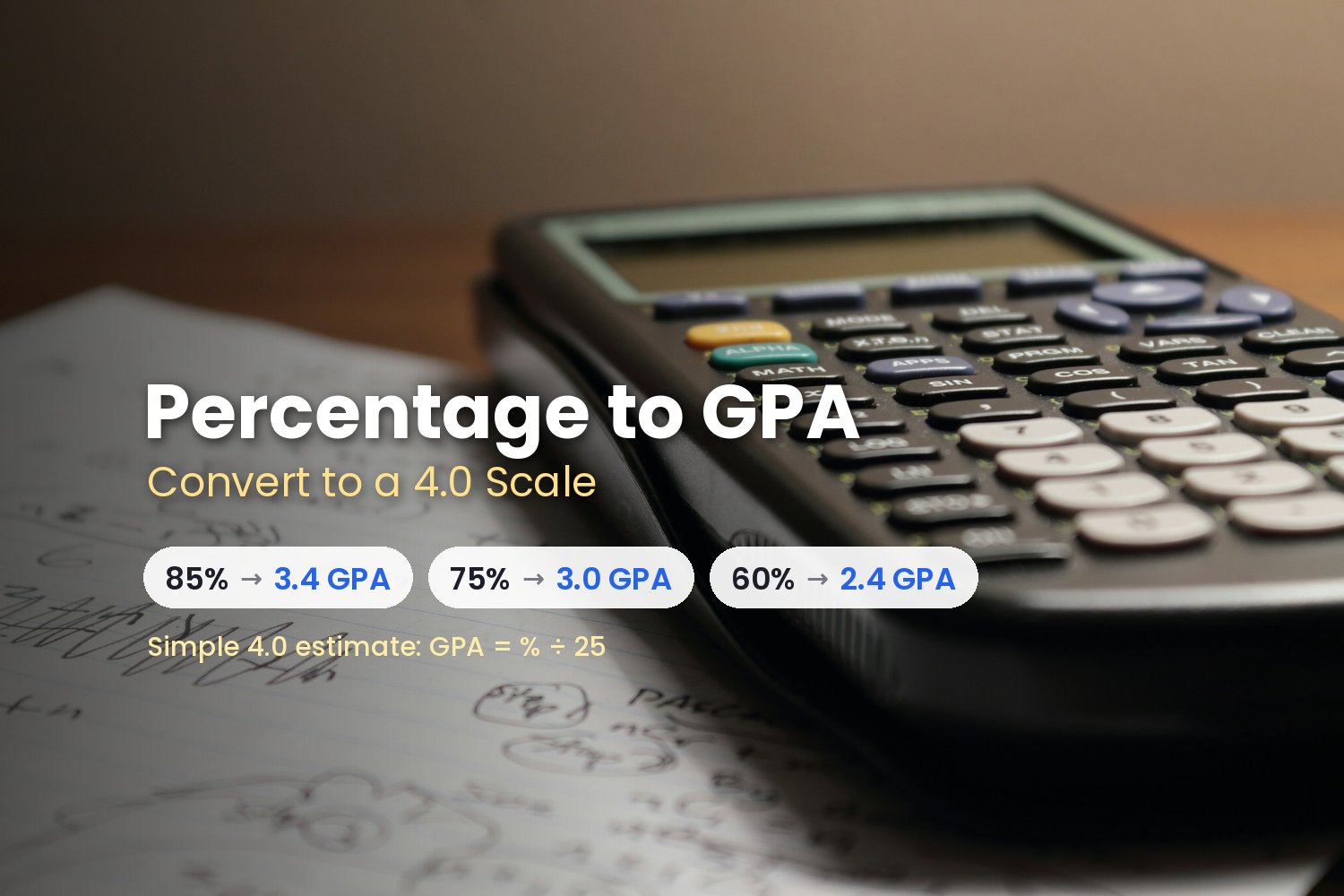
- A simple linear formula gives 85% = 3.4.
Same percentage, three different answers. That is why the first rule of converting percentage to GPA is: check what scale your school or the receiving institution uses.
Method 1: The Common US 4.0 Scale (Letter-Grade Bands)
College Board’s BigFuture describes the following as one commonly used system for US high schools, while noting that schools may calculate GPA differently and that it is not necessarily a formula for your true GPA:
| Letter grade | Percent range | GPA points |
|---|---|---|
| A | 90–100 | 4.0 |
| B | 80–89 | 3.0 |
| C | 70–79 | 2.0 |
| D | 66–69 | 1.0 |
| E/F | Below 65 | 0.0 |
Source: College Board BigFuture (ranges reproduced as published). Many schools also use plus/minus grades (for example A- or B+) with their own point values.
How to use it: convert each course percentage to a letter grade, take the grade points, then average them. Example from five classes: A, A, A, B, C = (4.0 + 4.0 + 4.0 + 3.0 + 2.0) ÷ 5 = 3.4 GPA.
Method 2: The Simple Linear Approximation
A quick estimate many students use is:
GPA = (Percentage ÷ 100) × 4, which is the same as GPA = Percentage ÷ 25.
(You may also see “percentage ÷ 20”; that gives a GPA on a 5.0 scale, not a 4.0 scale, so be careful which one you use.)
Examples:
- 80% ÷ 25 = 3.20
- 72% ÷ 25 = 2.88
- 90% ÷ 25 = 3.60
Caveat: this is a rough proportional estimate, not an official conversion. Because most grading scales give a full 4.0 well below 100%, the linear method usually understates GPA for strong students (90% gives 3.6 here but 4.0 on the BigFuture scale). Use it only for a quick idea, never for an application unless the institution explicitly asks for it.
Method 3: Pakistan HEC Recommended Scale
For students in Pakistan, HEC’s Policy Guidelines for Implementation of Uniform Semester System recommends this equivalence between percentage and grade points for the semester system:
| Grade | Grade points | Percentage (semester system) |
|---|---|---|
| A | 3.67–4.00 | 85 and above |
| A- | 3.34–3.66 | 80–84 |
| B+ | 3.01–3.33 | 75–79 |
| B | 2.67–3.00 | 71–74 |
| B- | 2.34–2.66 | 68–70 |
| C+ | 2.01–2.33 | 64–67 |
| C | 1.67–2.00 | 61–63 |
| C- | 1.31–1.66 | 58–60 |
| D+ | 1.01–1.30 | 54–57 |
| D | 0.10–1.00 | 50–53 |
| F | 0.00 | Below 50 |
Source: HEC Policy Guidelines, section 13.1 (Fractionalized Grading System).
Notice that HEC gives a range of grade points for each grade. Universities apply it differently: some award the top point of each band (A = 4.00, A- = 3.66, B+ = 3.33 and so on), as COMSATS University Islamabad does in its published notification. Our GPA calculator uses fixed values (A 4.00, A- 3.67, B+ 3.33, B 3.00, B- 2.67, C+ 2.33, C 2.00, C- 1.67, D+ 1.33, D 1.00, F 0). Always check your own university’s handbook.
HEC also publishes a separate table for older annual-system degrees (for example, 85% and above = A, 4.00; 70–84% = A-, 3.66–3.99; 55–69% = B, 2.66–3.65; 45–54% = C, 1.66–2.65; 33–44% = D, 1.00–1.65; below 33% = F). Going the other way? Read our guide on CGPA to percentage in Pakistan.
A Note on India (CBSE)
CBSE’s well-known “multiply by 9.5” rule converts CGPA to percentage (indicative percentage = 9.5 × CGPA) on CBSE’s 10-point scale. It is not a percentage-to-4.0-GPA formula, so do not use it for that. CBSE has also stated that it does not calculate or declare an overall percentage and that any such calculation may be done by the admitting institution or employer. For CGPA on a 10-point scale, try our CGPA calculator.
Percentage to GPA Conversion Table (Side-by-Side)
This table shows how much the result depends on the scale. HEC values show the grade-point band.
| Percentage | Linear (% ÷ 25) | Common US scale (BigFuture) | Pakistan HEC (semester) |
|---|---|---|---|
| 95% | 3.80 | 4.0 (A) | A, 3.67–4.00 |
| 90% | 3.60 | 4.0 (A) | A, 3.67–4.00 |
| 85% | 3.40 | 3.0 (B) | A, 3.67–4.00 |
| 80% | 3.20 | 3.0 (B) | A-, 3.34–3.66 |
| 75% | 3.00 | 2.0 (C) | B+, 3.01–3.33 |
| 70% | 2.80 | 2.0 (C) | B-, 2.34–2.66 |
| 65% | 2.60 | Not clearly covered* | C+, 2.01–2.33 |
| 60% | 2.40 | 0.0 (E/F) | C-, 1.31–1.66 |
| 50% | 2.00 | 0.0 (E/F) | D, 0.10–1.00 |
*BigFuture’s published table lists D as 66–69 and E/F as below 65, so exactly 65% falls between bands. Your school’s own policy decides.
How to Convert a Full Transcript to GPA (Credit-Weighted)
A transcript GPA is not a simple average of percentages. Follow these steps:
- List every course with its percentage and credit hours (or units).
- Convert each course percentage to grade points using the correct scale (your school’s, or the one the receiving institution specifies).
- Multiply grade points by credit hours for each course. This gives “quality points”.
- Add up all quality points and add up all credit hours.
- Divide total quality points by total credit hours.
Worked example (common US scale):
| Course | Percentage | Grade points | Credits | Quality points |
|---|---|---|---|---|
| Mathematics | 92% | 4.0 (A) | 3 | 12.0 |
| Physics | 84% | 3.0 (B) | 4 | 12.0 |
| English | 76% | 2.0 (C) | 3 | 6.0 |
| Computer Lab | 95% | 4.0 (A) | 2 | 8.0 |
| Total | 12 | 38.0 |
GPA = 38.0 ÷ 12 = 3.17. A simple unweighted average of the four grade points would give 3.25, which shows why credits matter. Our GPA calculator does this weighting for you.
Compare with the linear method: the credit-weighted average percentage here is (92×3 + 84×4 + 76×3 + 95×2) ÷ 12 = 1,030 ÷ 12 = 85.83%, and 85.83 ÷ 25 = 3.43. Different again, so state which method you used whenever you report a converted GPA. You can check the percentage arithmetic with our percentage calculator.
Common Mistakes to Avoid
- Assuming one formula is official everywhere. The linear “% ÷ 25” method is an estimate, not a standard.
- Mixing up 4.0, 5.0 and 10-point scales. Dividing by 20 gives a 5-point result; CBSE CGPA is on a 10-point scale.
- Using the CBSE 9.5 rule backwards to get a 4.0 GPA. It converts CGPA to percentage only.
- Ignoring credit hours. A 4-credit course should count more than a 1-credit lab.
- Converting your overall percentage instead of each course. Letter-grade scales work course by course, so converting the aggregate can give a different answer.
- Rounding too early. Keep two decimals until the final step.
- Reporting a self-converted GPA as official. If a form asks for GPA and your transcript does not show one, say it is an estimate or report your original percentage.
When to Use WES or an Official Evaluation
If you are applying abroad for university admission, immigration or professional licensing, the receiving institution may require an official credential evaluation rather than your own calculation. Services such as World Education Services (WES) evaluate international transcripts and can report a US-equivalent GPA. WES also offers a free iGPA calculator for a preview, but only the official evaluation counts where one is required. As College Board notes, many colleges recalculate GPA using their own criteria, so always check the specific admissions or scholarship instructions first.
Frequently Asked Questions
What is 80 percent in GPA on a 4.0 scale?
It depends on the scale. The linear estimate gives 3.20. On the common US scale described by BigFuture, 80% is a B (3.0). Under Pakistan’s HEC semester table, 80% is an A- (3.34–3.66).
Is GPA = percentage ÷ 25 the official formula?
No. It is a quick proportional approximation. No global authority has made it official. Use your institution’s grading scale or an official evaluation when accuracy matters.
How do I calculate GPA from percentage for multiple subjects?
Convert each subject’s percentage to grade points, multiply by its credit hours, add the results, and divide by total credit hours. Our GPA calculator handles this automatically.
Can I convert CBSE marks to a 4.0 GPA using 9.5?
No. CBSE’s 9.5 multiplier gives an indicative percentage from CGPA on a 10-point scale. It does not convert anything to a 4.0 GPA. Universities abroad usually rely on their own policy or a credential evaluation.
Should I put a converted GPA on my application?
Only if the application asks for it and allows self-reported conversions. Many ask for your grades exactly as shown on your transcript, and some require an official evaluation such as WES. When in doubt, report your original percentage and ask the admissions office.
Final Thoughts
Converting percentage to GPA is simple arithmetic once you know which scale applies, and that is the hard part. Use the linear method for a rough idea, your institution’s letter-grade bands for a real figure, and an official evaluation for applications that require one. Start with our GPA calculator to work out your result in seconds.
Sources
- College Board BigFuture, “How to Calculate Your GPA on a 4.0 Scale”: bigfuture.collegeboard.org
- Higher Education Commission Pakistan, Policy Guidelines for Implementation of Uniform Semester System (sections 13.1 and 13.2): hec.gov.pk (PDF)
- COMSATS University Islamabad, grading criteria notification: comsats.edu.pk (PDF)
- CBSE, Circular No. 24 (2010) on indicative percentage: cbse.gov.in (PDF)
- CBSE, notice on calculation of percentage: cbse.gov.in (PDF)
- World Education Services (WES), education evaluations: wes.org