Is Elon Musk on the Autism Spectrum? What He Has Actually Said
Medical Disclaimer: This article is for informational purposes only and does not constitute medical advice. Autism diagnosis should only be made by qualified healthcare professionals. If you or someone you know is seeking an autism evaluation, consult a psychiatrist, clinical psychologist, or neuropsychologist. Do not use this content for self-diagnosis.
In May 2021, Elon Musk announced to the world that he has Asperger’s syndrome. Millions of people heard the statement on Saturday Night Live, and for many of them, it triggered a personal question: Don’t I have this too?
Maybe you recognized yourself when you read about the peculiarities of communication that can be observed in his biography or noticed during an interview. You may have thought the same when reading the entrepreneur’s posts on X. However, it is not entirely correct to apply this diagnosis to yourself based on someone else’s words and actions, let alone those of a public figure.
Most of the world’s press summed up Musk’s statement in a few words: “Elon Musk says he has Asperger’s syndrome.” However, this phrasing is missing some important details. First, the term “Asperger’s syndrome” is no longer in official use. The DSM-5 diagnostic manual no longer includes this diagnosis; instead, it refers to autism spectrum disorder. Second, a famous name does not change what the diagnosis means: the same criteria apply to Musk as to anyone else.
This article will explore what exactly Musk said, what this diagnosis means today, and how ordinary people can tell the difference between simple difficulties in understanding others and a genuine need for help.
What Did Musk Actually Say?
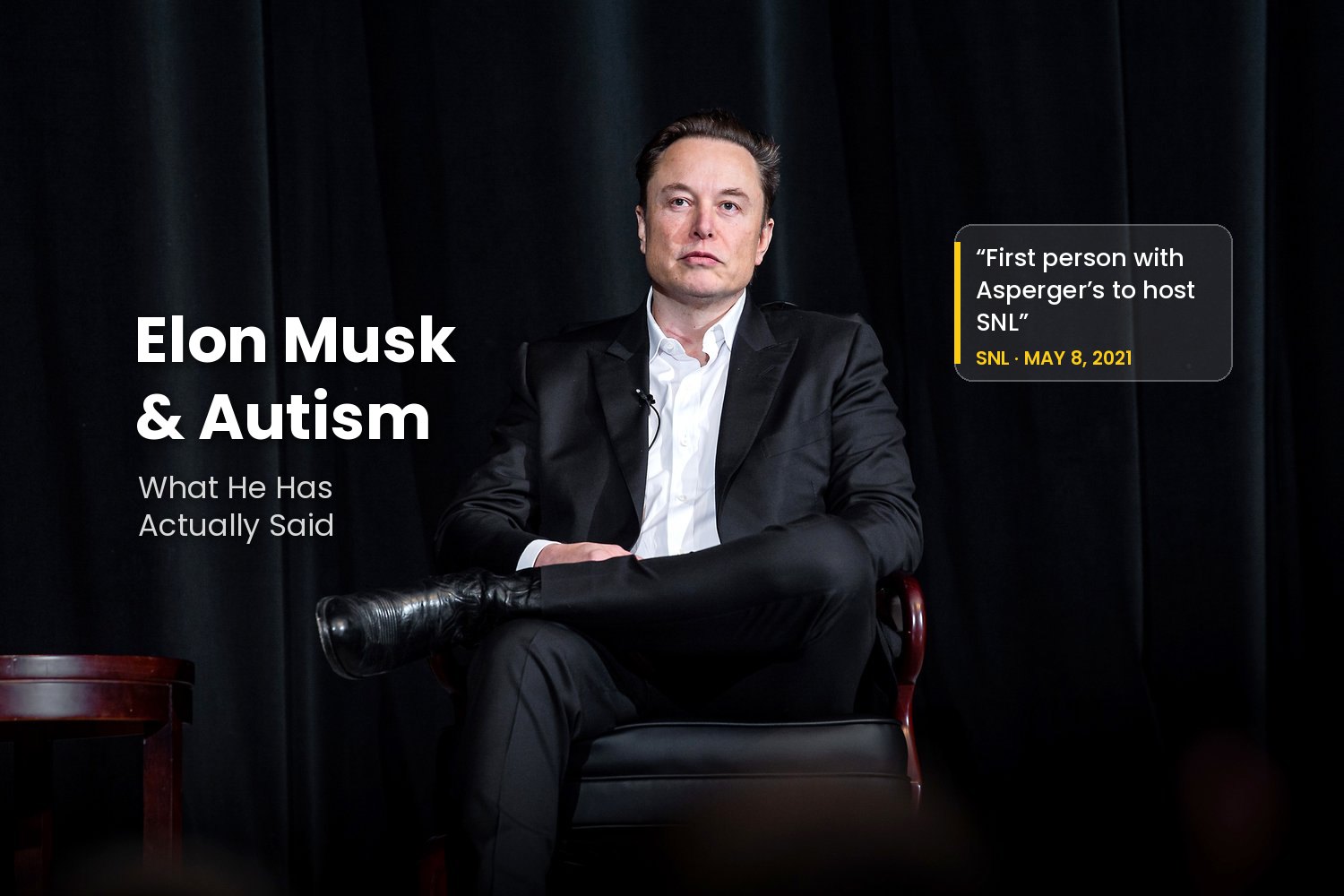
May 8, 2021. Saturday Night Live (as reported by BBC News).
Musk is on stage in New York doing his monologue when he drops this line: “I’m actually making history tonight as the first person with Asperger’s to host SNL.” Then he added, “Or at least the first to admit it.” He also talked about his flat vocal tone, saying he doesn’t “always have a lot of intonation or variation” in how he speaks. And he addressed his tendency to post things that offend people: “I know I say or post strange things, but that’s just how my brain works.”
Why He Says “Asperger’s”
So why does Musk refer to “Asperger’s” rather than “autism spectrum disorder”? It comes down to the terminology he has traditionally used to describe himself.
Under the DSM-5, individuals who previously met criteria for Asperger’s disorder are diagnosed with autism spectrum disorder, often at Level 1, which denotes a need for support, but the lowest degree of it.
This group is characterized by the absence of intellectual disability and of clinically significant early language delay, alongside persistent difficulty interpreting social cues. Musk’s use of the term “Asperger’s” therefore reflects the diagnostic vocabulary in place before the revision.
How Musk Describes His Own Brain
Over the years, Musk has pointed to a few specific things.
Intense Focus
He’s talked about losing himself in technical problems for hours. Sometimes days. Skipping sleep, social plans. That kind of sustained attention shows up a lot in autistic adults.
Direct Communication
He’s admitted that social rules don’t come naturally. Sometimes he has to clarify when he’s being serious because people can’t tell. That preference for straight talk, no sugarcoating, is something a lot of autistic people recognize.
Routine and Structure
Musk is widely known for very long working hours. Some observers read this as a preference for structure, but that is speculation; he has not tied it to his diagnosis.
None of this alone means anything. Plenty of non-autistic people are intense and direct. But together? They do paint a picture that clinicians would recognize.
How Common Is Autism Right Now?
According to the CDC’s April 2025 report, about 1 in 31 eight-year-olds at 16 U.S. monitoring sites had been identified with autism in 2022. That’s up from 1 in 36 in 2020 and 1 in 150 in 2000.
The CDC links much of this rise to more and earlier identification, including among groups that were previously underdiagnosed, rather than claiming a clear rise in how many children are autistic; the causes of the increase are still being studied. Boys were identified about 3.4 times as often as girls. And among children with available cognitive test data, about 40% (39.6%) also had an intellectual disability. That really shows how wide the spectrum is.
Musk is just one face in that picture.
Other Famous People Who’ve Talked About Autism
Musk isn’t alone here.
Sir Anthony Hopkins has said he was diagnosed with Asperger’s late in life, in his 70s; he first spoke about it publicly in 2017.
Greta Thunberg has described her autism as central to how she approaches her work.
Dan Aykroyd has said he was diagnosed with Tourette’s at 12 and has spoken publicly about having Asperger’s. Since he hosted SNL in 2003, many viewers pointed out that Musk was likely not the first host with Asperger’s, which is perhaps why Musk hedged with “or at least the first to admit it.”
Temple Grandin has spent her whole career arguing that autistic thinking patterns are an asset in detail-oriented fields.
So Musk isn’t doing anything new. He’s just putting a contemporary face on a conversation that’s been happening for a while.
What Musk’s Disclosure Actually Changed
After the SNL episode, business psychologist Melanie Katzman told CNN Business that “recognizing and embracing this neurodiversity helps build strong, inventive, and supportive teams.” She argued that conditions like autism should be viewed not as pathologies but as “super powers.”
And honestly? That reframing did shift things. Autism stopped being purely a childhood topic. It became something adults could openly discuss—and build careers around.
A billionaire’s success story isn’t representative. Many autistic people need substantial daily support with communication, sensory regulation, or independent living. His disclosure helped reduce stigma. It also flattened a complex condition into something that looks achievable.
Signs of Autism in Adults
If something here is making you wonder, you’re not alone. A lot of autistic adults were never evaluated as kids, especially if they were verbal and academically capable. That is one reason teachers who build activities that engage every kind of student often notice differences in how children learn long before anyone uses a label.
Common Signs
- Taking sarcasm or idioms literally (the NHS lists this among signs in adults)
- Preferring direct communication over small talk
- Deep, narrow focus on specific interests
- Difficulty in unstructured social settings
- Sensory sensitivity to sounds, lights, or textures
- Distress when routines change
- Trouble with planning or organizing
None of these alone confirms anything. But together, especially if they’ve been present since childhood, they’re worth discussing with a professional. The National Autistic Society has a clear overview of what autism is and how it can show up.
Frequently Asked Questions
Did Elon Musk actually get an autism diagnosis?
He’s publicly stated he has Asperger’s, most notably during his SNL monologue. But he hasn’t released any formal clinical evaluation. What’s public is a self-disclosure, not documented medical proof. That’s an important distinction that most articles blur.
Is Asperger’s still a real diagnosis?
Not officially. The DSM-5 folded it into autism spectrum disorder in 2013. People diagnosed before then are now typically described as having Level 1 autism. Many still use “Asperger’s” informally because it’s familiar.
What’s Level 1 autism?
It’s the DSM-5 category for autistic people who need the least daily support. It generally overlaps with what used to be called Asperger’s or high-functioning autism. People at this level may struggle with social cues but can often manage daily life with minimal help.
Can autistic adults be successful in demanding careers?
Absolutely. Traits like intense focus and systematic thinking (the kind of skill built by critical thinking exercises) can be valuable in technical and analytical fields. But success varies enormously across the spectrum. It depends more on individual circumstances and support needs than on the diagnosis itself.
How do adults get evaluated for autism?
Start with a referral from a primary care doctor to an adult psychiatrist or clinical psychologist. Evaluation typically includes structured interviews, developmental history review, and standardized tools like the ADOS-2. The National Institute of Mental Health notes that autism “can be diagnosed at any age,” even though symptoms generally appear in the first two years of life.
How many people have autism today?
The CDC’s April 2025 report estimates that about 1 in 31 eight-year-olds at its U.S. monitoring sites had been identified with autism in 2022. That’s up significantly from 2000, and the CDC points to increased identification as a major factor.
Sources
- CDC MMWR (April 2025): Prevalence and Early Identification of Autism Spectrum Disorder Among Children Aged 4 and 8 Years, 2022
- BBC News: Elon Musk reveals he has Asperger’s on Saturday Night Live
- The Washington Post: Elon Musk reveals he has Asperger’s syndrome during SNL monologue
- CNN Business: What Elon Musk’s Asperger’s comment could mean for the business world
- Snopes: Did Elon Musk Reveal on ‘SNL’ He Had Asperger’s?
- Metro: Sir Anthony Hopkins opens up on Asperger’s diagnosis
- UPI: Dan Aykroyd reveals struggles with Asperger and Tourette’s
- National Institute of Mental Health: Autism Spectrum Disorder
Photo: U.S. Air Force / Trevor Cokley, public domain, via Wikimedia Commons