
Largest Ocean in the World: Size, Depth, Facts & Why the Pacific Is So Massive
You already know the answer, and you are right. The Pacific Ocean isn’t just the largest ocean on Earth. It’s a world of its own. The Pacific is so vast that it swallows every piece of land on Earth with room to spare. It is older than the dinosaurs, deeper than any mountain is tall, and is slowly, almost imperceptibly, shrinking.
This guide gives you every key fact about the world’s biggest ocean, ranks all five oceans by size, and explains the science behind why the Pacific ended up so dominant.
What Is the Largest Ocean in the World?
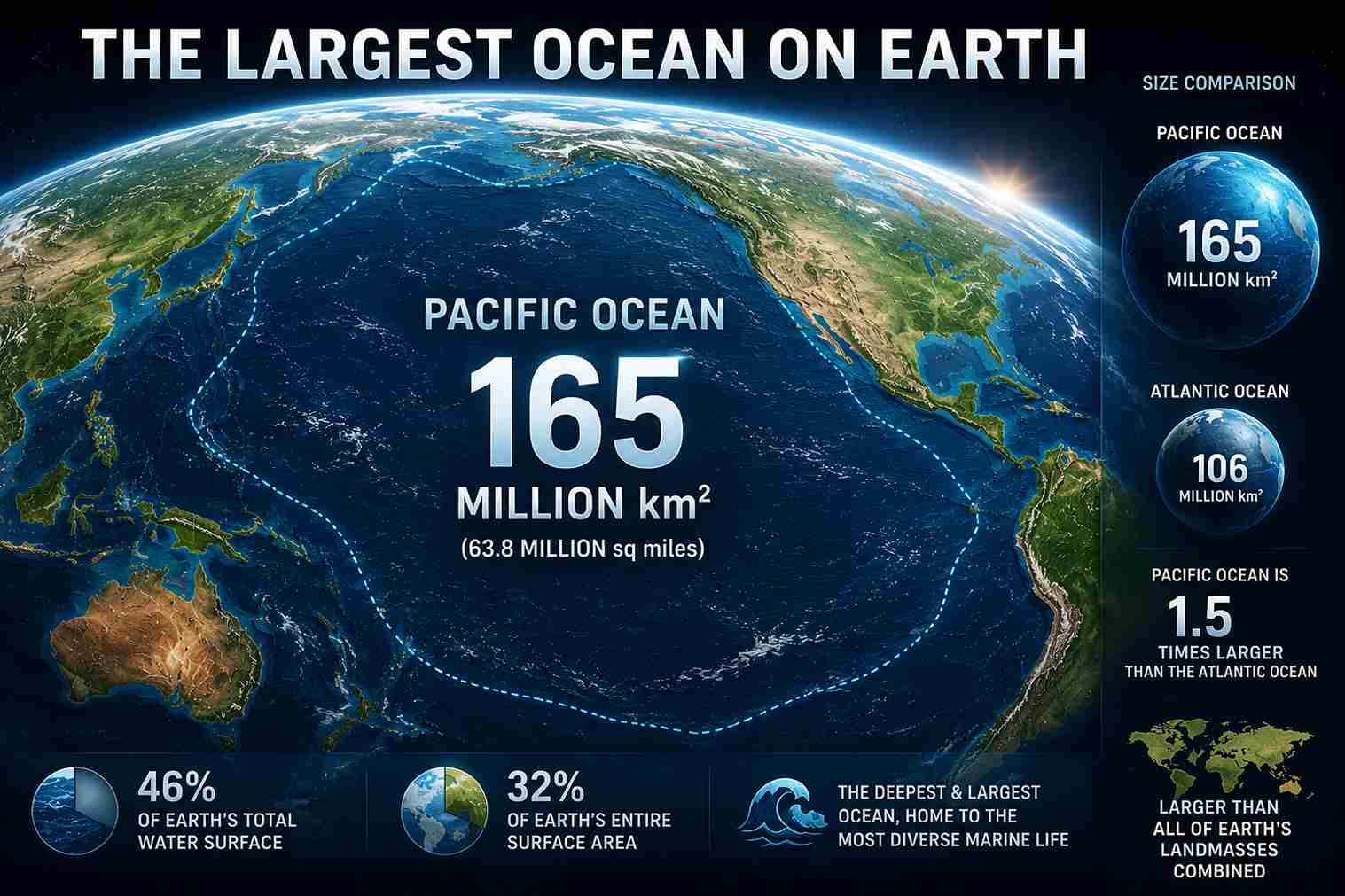
The largest ocean in the world is the Pacific Ocean. It covers approximately 165 million square kilometres (about 63.8 million square miles), which accounts for roughly 46% of Earth’s total water surface and about 32% of the planet’s entire surface area.
The Pacific is more than 1.5 times the size of the second-largest ocean, the Atlantic, and larger than all of Earth’s landmasses combined.
How Big Is the Pacific Ocean, Exactly?
Numbers help, but they do not do full justice to the scale. The Pacific Ocean covers more than 155 million square kilometres (60 million square miles) and averages a depth of 4,000 metres (13,000 feet).
From north to south, it stretches roughly 15,500 kilometres, from the Bering Strait all the way down to Antarctica. At its widest point near the equator, it spans approximately 19,800 kilometres from Indonesia to the coast of Colombia.
Bigger Than All of Earth’s Land Combined
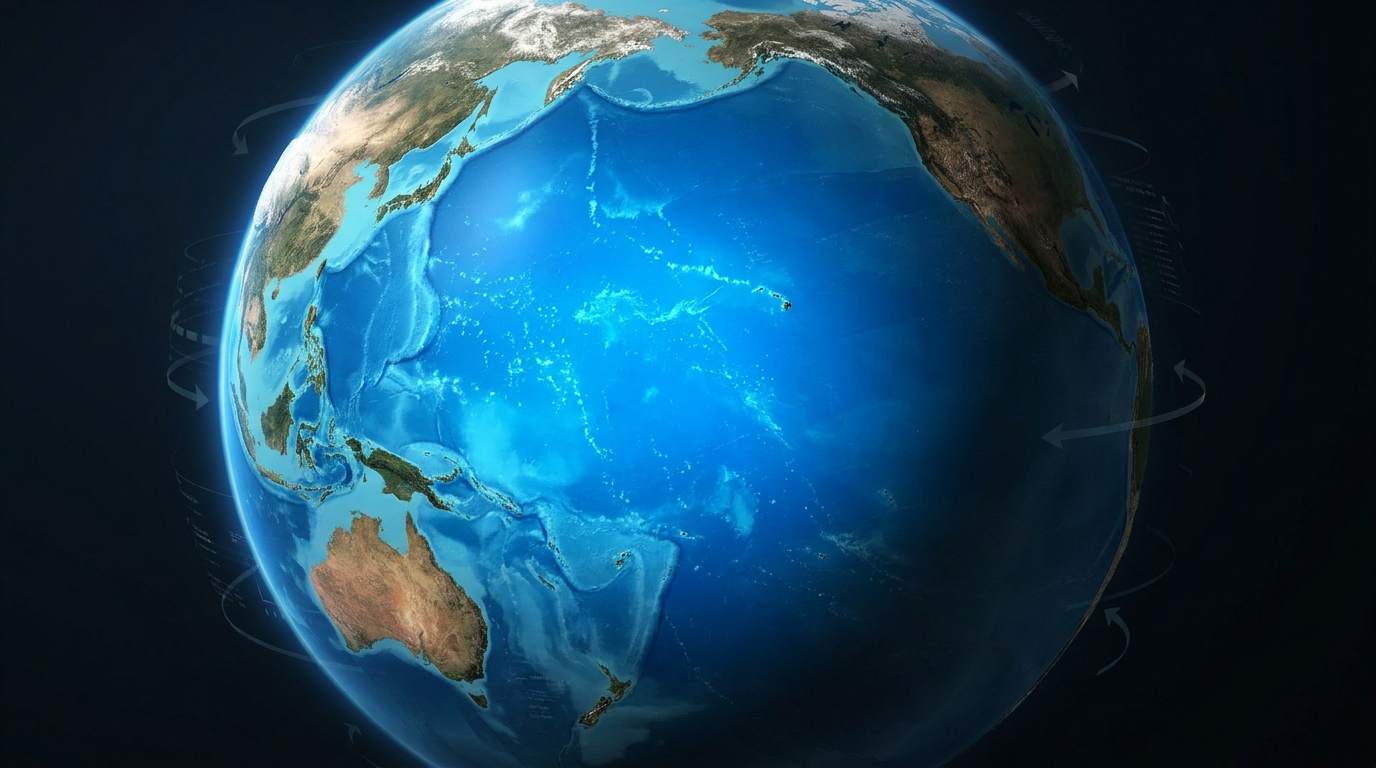
Here is a figure that takes a moment to absorb: the Pacific is larger than the landmass of all the continents combined. Every continent, every island, every desert and mountain range, stacked together, would still not cover the Pacific. The ocean holds more than 700 million cubic kilometres of water and contains roughly 25,000 islands, more than all other oceans put together.
Deeper Than Any Other Ocean
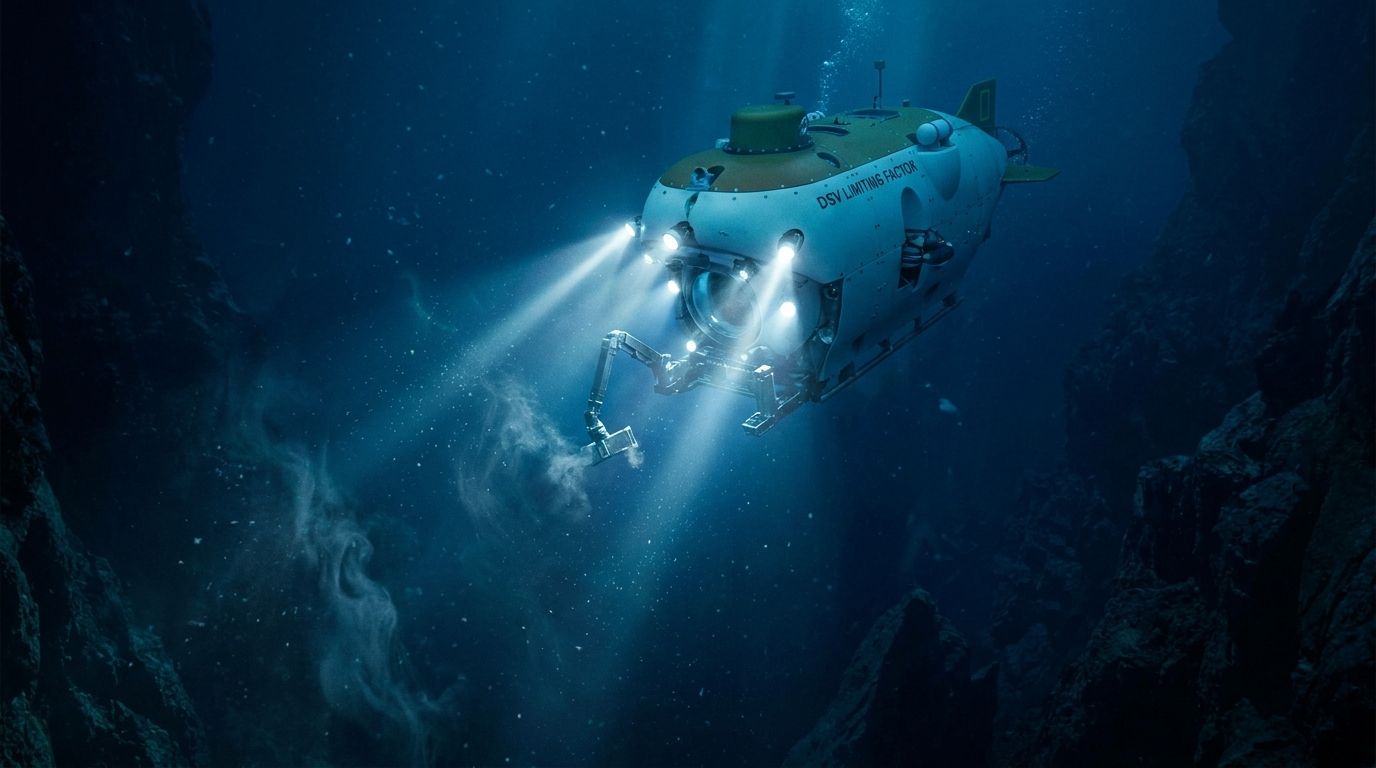
The Pacific Ocean does not just win in terms of area. Its mean depth (excluding adjacent seas) is 4,280 metres, and its greatest known depth is 11,034 metres, the greatest depth found in any ocean. To put that in terms you can picture: if you placed Mount Everest at the bottom of Challenger Deep, the summit would still sit more than 2,000 metres below the surface.
Three manned expeditions have reached Challenger Deep. The first was in 1960, when Swiss oceanographer Jacques Piccard and US Navy Lieutenant Don Walsh descended in the bathyscaphe Trieste, a journey that took nearly five hours each way.
Only three manned expeditions have ever reached Challenger Deep. The first took place in 1960, when Swiss oceanographer Jacques Piccard and US Navy Lieutenant Don Walsh descended in the bathyscaphe Trieste, a remarkable trip that took nearly five hours each way.
The Five Oceans Ranked by Size
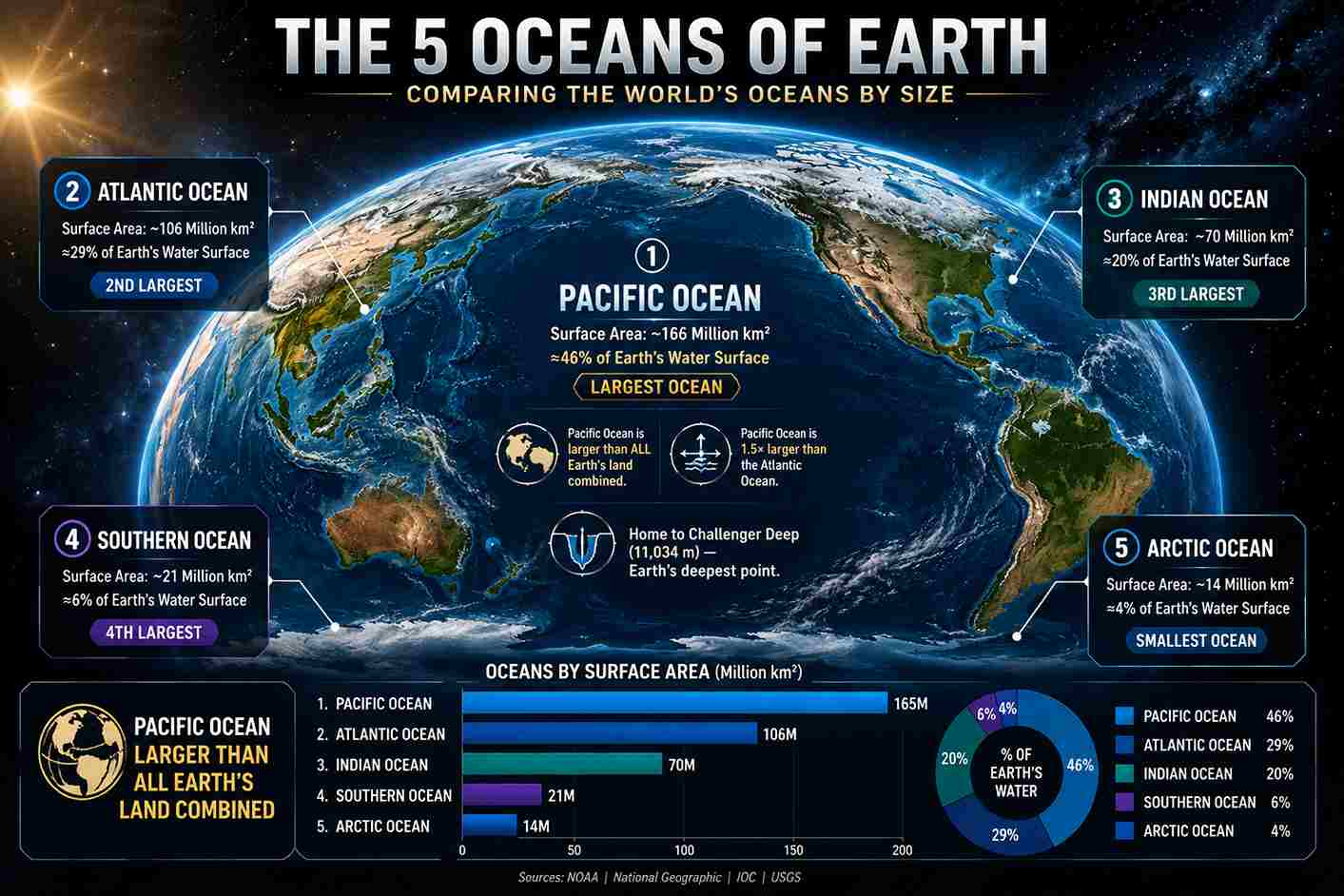
There are five recognised oceans. Here is how they compare:
| Ocean | Surface Area | % of Earth’s Water Surface |
| Pacific | ~165 million km² | ~46% |
| Atlantic | ~106 million km² | ~29% |
| Indian | ~70 million km² | ~20% |
| Southern | ~21 million km² | ~6% |
| Arctic | ~14 million km² | ~4% |
The Pacific is not just the largest ocean in the world by a narrow margin. Combined, the Atlantic and Indian Oceans are still smaller than the Pacific alone. The Southern (Antarctic Ocean) was formally recognised by the International Hydrographic Organization in 2000 and encircles Antarctica. The Arctic Ocean, the smallest and shallowest of the five, sits almost entirely within the Arctic Circle.
The Atlantic basin is the second largest, followed by the Indian Ocean basin, the Southern Ocean, and finally the Arctic Ocean basin.
Why is the Pacific Ocean so Large?
Its vastness is the legacy of Earth’s restless crust and ancient oceans long since vanished.
It is the Last Remnant of an Ancient Superocean
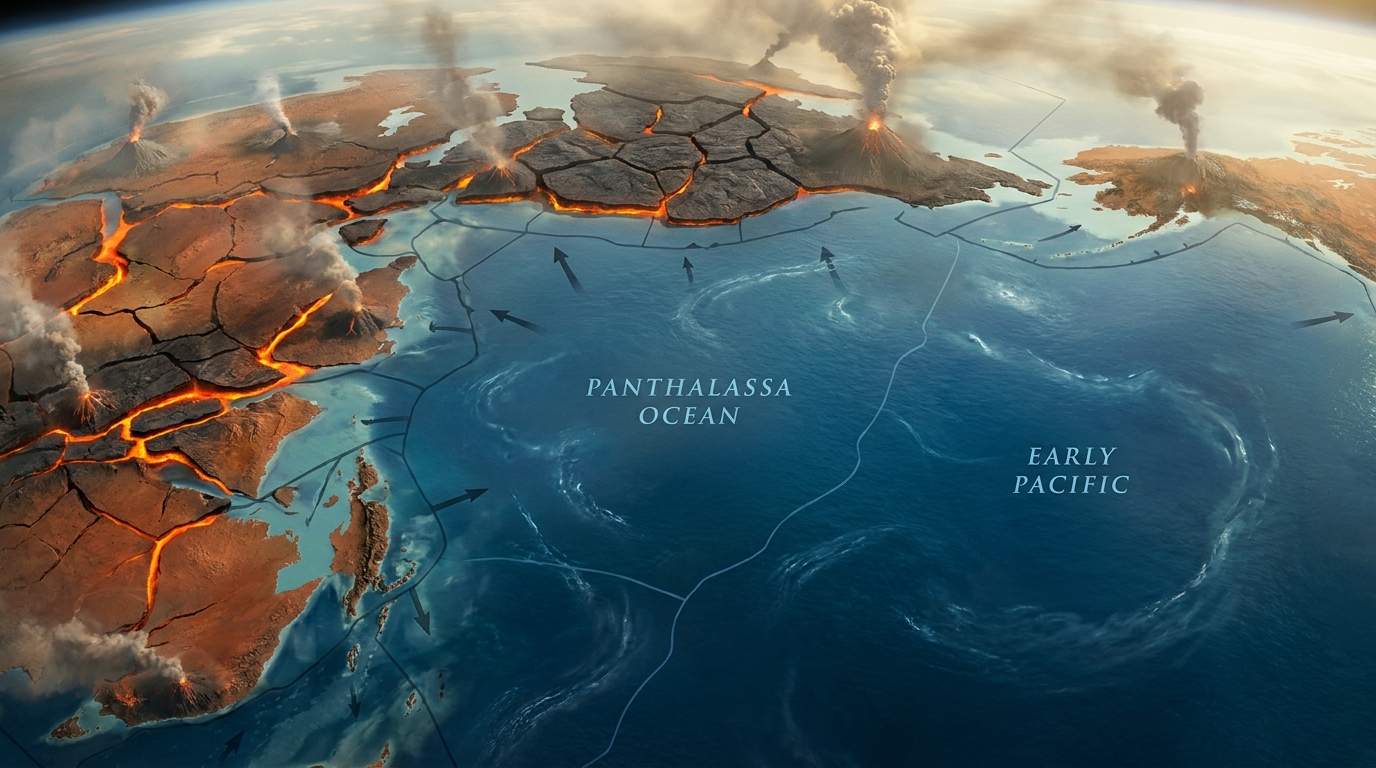
The Pacific did not just appear. It is the surviving portion of Panthalassa, a world-spanning superocean that existed when all of Earth’s land was joined in the supercontinent Pangaea, roughly 300 million years ago.
As Pangaea fragmented and the continents drifted apart, Panthalassa shrank. The Pacific is essentially what remains of Panthalassa, according to Susanne Neuer, founding director of the School of Ocean Futures at Arizona State University.
The Pacific basin is the oldest existing ocean basin; its oldest rocks have been dated at about 200 million years.
The Pacific Is Actually Shrinking
This is the detail that surprises most people. Due to the movement of tectonic plates, the Pacific Ocean is currently shrinking by roughly 2.5 centimetres per year on three sides. The Americas are drifting westward, Asia is moving eastward, and the Pacific Plate is being pushed beneath surrounding continental plates in a process called subduction.
In contrast, the Atlantic Ocean is increasing in size. In roughly 200 million years, the Pacific Ocean may no longer hold the title of largest ocean in the world, though that is a problem for a different species entirely.
What Makes the Pacific Ocean Unique?
Beyond raw size, the Pacific shapes life on Earth in ways that touch you every year, through your weather, your food, and the geological forces that have built entire island chains.
The Ring of Fire
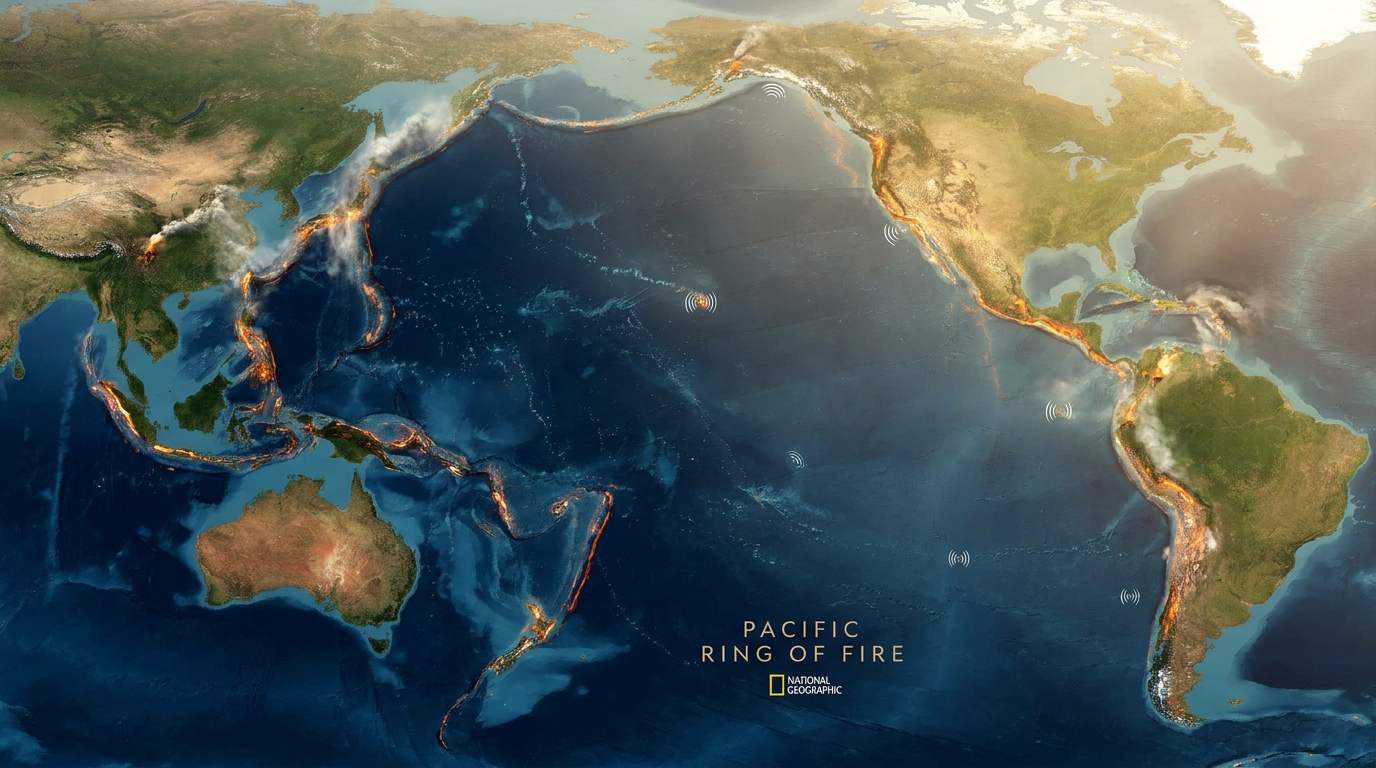
Running almost all the way around the Pacific’s edges is the Ring of Fire, a horseshoe-shaped zone of intense geological activity.
This zone hosts approximately 75% of the world’s active and dormant volcanoes, and about 90% of the world’s earthquakes occur along its boundaries. The Ring of Fire exists because the Pacific Plate and several smaller plates are being forced under the surrounding continental plates, producing deep ocean trenches, volcanic island arcs, and powerful earthquakes. Countries sitting along the Ring of Fire, Japan, Indonesia, the Philippines, Chile, and the United States, experience this activity regularly.
El Niño and La Niña
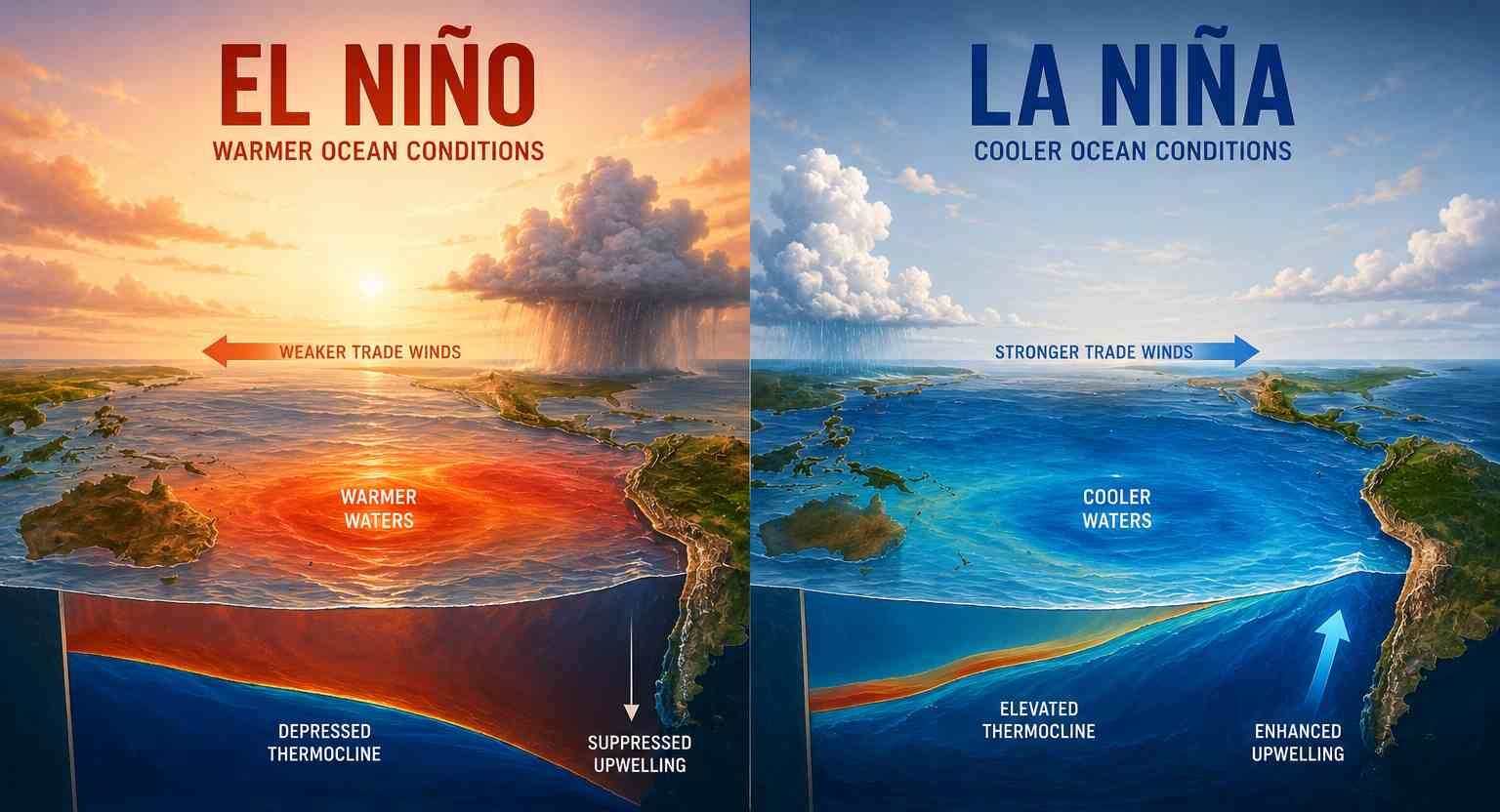
El Niño and La Niña are opposite phases of a natural climate pattern called the El Niño-Southern Oscillation (ENSO) cycle.
The Pacific’s sheer mass makes it the planet’s primary heat engine. It absorbs an enormous amount of solar energy and redistributes it through ocean currents, directly influencing rainfall, temperature, and weather extremes across every continent.
The most well-known expression of this is the El Niño–Southern Oscillation (ENSO) cycle.
During an El Niño event, warmer-than-usual surface water spreads across the central and eastern Pacific, suppressing rainfall in Australia and Southeast Asia while driving heavy precipitation into South America and the southern United States.
La Niña reverses the pattern. Both cycles affect billions of people who live far from the ocean’s shores.
Marine Biodiversity
The Pacific supports the greatest variety of marine life found in any ocean.
The Coral Triangle, spanning Indonesia, Malaysia, the Philippines, Papua New Guinea, the Solomon Islands, and Timor-Leste, contains over 75% of all known coral species and more than 3,000 species of reef fish.
The Great Barrier Reef, the world’s largest coral reef system at over 2,300 kilometres long, lies along the western edge of the Pacific off Australia’s coast. The ocean is also home to blue whales, humpback whales, sea otters, multiple shark species, and populations of tuna and salmon that feed hundreds of millions of people.
Not all of this is good news. The Great Pacific Garbage Patch, a region in the North Pacific where ocean currents concentrate plastic debris, now covers an area roughly twice the size of Texas. Overfishing has also reduced fish populations in several key zones, including the Okhotsk Sea, where catches have fallen by at least half since the 1990s.
Who Named the Pacific Ocean, and Why?
The name carries a story worth knowing. Ferdinand Magellan gave the ocean its name in 1521, from the Latin word “pacificus”, meaning “peaceful”, after experiencing calm seas following a brutal passage through the strait at South America’s southern tip.
Before Magellan reached it, Spanish explorer Vasco Núñez de Balboa had become the first European to sight the ocean from its eastern shore in 1513, naming it “Mar del Sur”, the Southern Sea.
The irony of the name is not lost on oceanographers. The Pacific generates the world’s most powerful typhoons, produces devastating tsunamis along the Ring of Fire, and contains the deepest, most geologically active trench on Earth. Peaceful it is not.
Frequently Asked Questions
1: What is the deepest point in the Pacific Ocean?
The deepest point in the Pacific Ocean and on Earth is Challenger Deep, located within the Mariana Trench in the western Pacific, east of the Mariana Islands. It reaches a depth of approximately 10,928 to 11,034 metres (roughly 36,000 feet) below sea level. The pressure at that depth is more than 1,000 times greater than at the surface, and temperatures hover just above freezing.
2: Is the Pacific Ocean bigger than all the land on Earth?
Yes. The Pacific Ocean covers approximately 165 million square kilometres. The total land area of all Earth’s continents combined is roughly 149 million square kilometres. The Pacific is larger by around 16 million square kilometres, equivalent to adding another Antarctica on top of all existing land.
3: 4: Why is the Pacific Ocean called “Pacific”?
Portuguese explorer Ferdinand Magellan gave it the name in 1521. After his fleet endured brutal storms passing through the strait at the southern tip of South America, the waters they entered seemed remarkably calm by comparison.
He called it “Mar Pacífico”, the peaceful sea. The name stuck, even though the Pacific is, by most measures, the least peaceful ocean on Earth.
Is the Pacific Ocean shrinking?
Yes, though not at a rate you would notice in a lifetime. The Pacific is shrinking by about 2.5 centimetres per year as tectonic plates push the Americas westward and Asia eastward, forcing the Pacific Plate downward at subduction zones.
The Atlantic, by contrast, is growing wider each year. Geologists estimate that in approximately 200 million years, the Pacific may no longer exist as a distinct ocean basin, the result of a process that has been underway since Pangaea began breaking apart.