
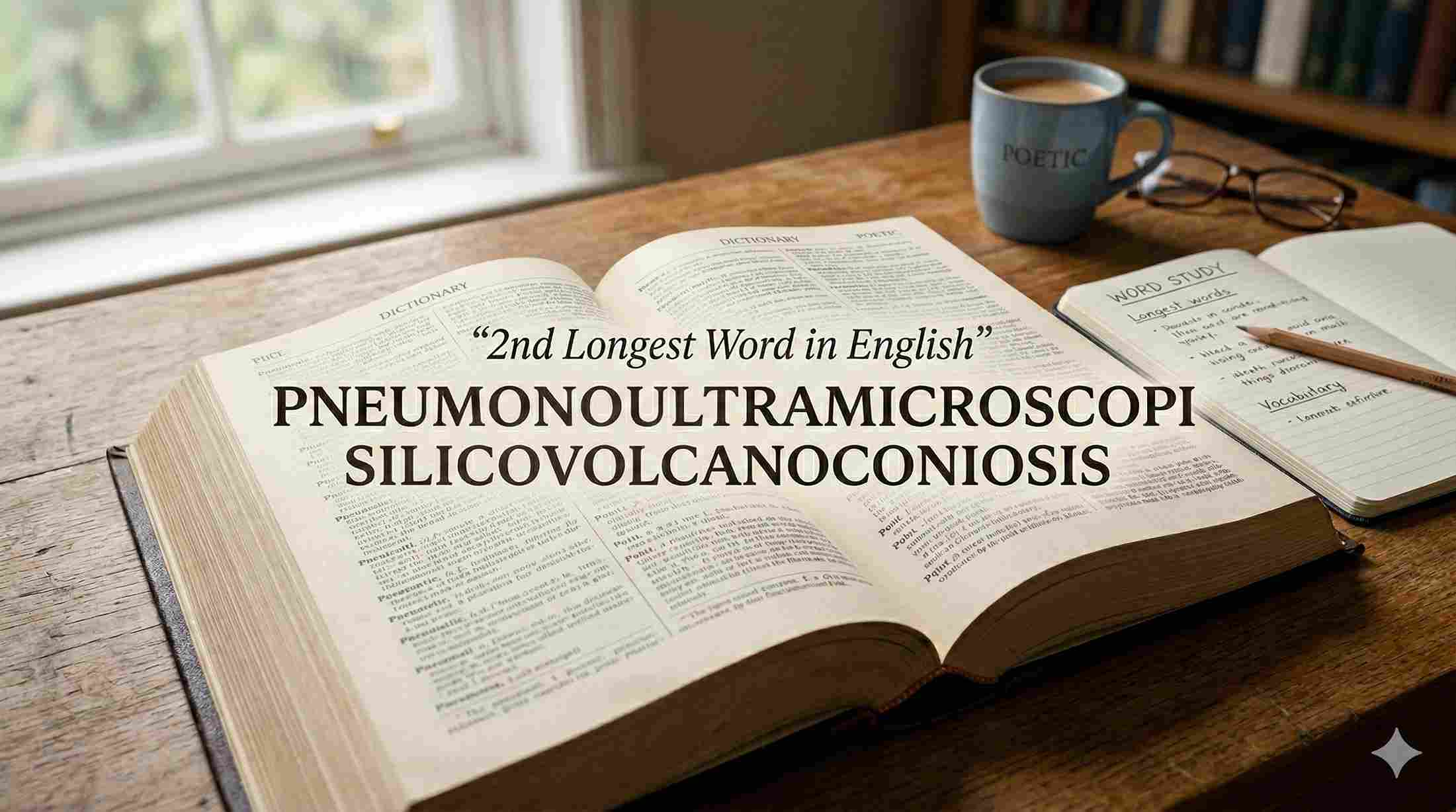
2nd Longest Word in English |Meaning, History, and Interesting Facts
One topic that consistently sparks curiosity is the 2nd longest word in English. Many people are familiar with the longest word, but very few know which word takes the second spot and what it actually means.
In this detailed guide, we will explore the 2nd longest word in English, understand its meaning, origin, pronunciation, and why such long words even exist. We’ll also clarify common misconceptions about long English words.
What is the 2nd Longest English word?
The second-longest word in the English language is normally said to be:
Pneumonoultramicroscopicsilicovolcanoconiosis
This word contains 45 letters.
Many dictionaries include it as the longest word. Still, technically, it is the second-longest word if we use the chemical name of the protein titin, which is, however, much longer (although this one is rarely recognized in any dictionary because of its length).
Pneumonoultramicroscopicsilicovolcanoconiosis means:
A pulmonary disease linked with the absorption of very fine silica particles, particularly from volcanoes.
We may divide it into parts to be more familiar with it:
- Pneumono – related to lungs
- Ultra – beyond
- Microscopic- very small.
- Silica -Silica (a mineral in sand and rocks)
- Volcano – volcanic
Coniosis- lung disease caused by dust. It is, in simple terms, a lung disease caused by the inhalation of extremely fine volcanic silica dust.
Is It the 2nd Longest Word?
This is somewhat disputed. The chemical name of the protein, Titin, is technically very long (more than 45 letters). Nevertheless, that word comprises approximately 244 separate names of amino acids and may take more than 34000 letters. Its excessive length and technicality do not allow it to be found in the larger dictionaries.
Consequently, Pneumonoultramicroscopicsilicovolcanoconiosis has been the longest known word in common dictionaries such as:
- Oxford English Dictionary
- Merriam-Webster
In the event we use the chemical name of titin as the longest possible word, then the 2nd longest word in the English language would be Pneumonoultramicroscopicsilicovolcanoconiosis.
Origin of the Word
Interestingly, this word was not discovered in medical research first. It was coined in 1935 by the president of the National Puzzlers’ League, Everett M. Smith. It was created more as a curiosity and to imitate long medical terminology rather than as a genuine scientific necessity.
Later, it was adopted into some dictionaries and is now recognized as a real word describing a specific lung condition similar to silicosis.
Why Do Such Long Words Exist?
Long words in English usually come from:
- Scientific terminology
- Medical vocabulary
- Chemical names
- Compound words formed from Greek and Latin roots
English borrows heavily from Latin and Greek, especially in medicine and science. When multiple descriptive components are combined into one word, the result can be extremely long.
For example, medical terms often describe:
- The affected organ
- The cause
- The condition
- The severity
All within a single word.
Pronunciation of the 2nd Longest Word
Pronouncing Pneumonoultramicroscopicsilicovolcanoconiosis can be challenging. It is typically pronounced as:
New-muh-no-ul-truh-my-kroh-skop-ik-sil-ih-koh-vol-kay-no-koh-nee-oh-sis. It takes practice, but breaking it into smaller syllables makes it manageable.
Comparison and Other Long English Words.
When talking of the 2nd-longest word in English, it would be useful to examine other long words:
1. Supercalifragilisticexpialidocious
This 34-letter term gained use in the film:
Mary Poppins
Though it is an impressive sound, it is created as an amusement and cannot be considered the longest word.
2. Antidisestablishmentarianism
This is a 28-letter word that means fighting against the abolition of the Church of England. It was once well known to be one of the longest non-technical words in English.
3. Floccinaucinihilipilification
A 29-letter word that signifies the worthlessness of estimating something.
Pneumonoultramicroscopicsilicovolcanoconiosis is much longer in comparison with these.
Does it Find Its Way into Everyday Speech?
No. The 2nd-longest English word is scarcely applied in everyday life. Physicians and researchers are fond of using shorter and more explicit words like:
- Silicosis
- Pneumoconiosis
- The extended one is a linguistic peculiarity rather than a practical medical designation.
Fun Facts About the 2nd Longest Word in English
- It has 45 letters.
- It contains 19 syllables.
- It was created partly for fun.
- It is a commonly used spelling contest.
- It was known due to its excessive length.
The Question of Why People Search the 2nd Longest Word in English.
Interest in language stimulates the desire to examine drastic cases in many individuals. The reason why long words are appealing is that they:
- Prove the plasticity of English.
- Demonstrate complicated constructions of words.
- Test spelling and pronunciation skills.
- Perform in quizzes and competition tests.
Such records are often sought after by students, people who love language, and trivia lovers.
The Science Behind the Word
This is a similar disease that has been characterized as the one described by Pneumonoultramicroscopicsilicovolcanoconiosis. Silicosis is an actual lung disease resulting from the inhalation of silica particles in the long run. It commonly affects:
- Miners
- Construction workers
Quarry workers. Excessive exposure to silica dust may cause lung inflammation and scarring, which can cause breathing problems.
Conclusion
The 2nd-longest word in English, Pneumonoultramicroscopicsilicovolcanoconiosis, is a fascinating example of how complex and flexible the English language can be. With 45 letters, it represents a medical condition caused by inhaling fine silica dust.
Although it is rarely used in everyday speech, it remains popular in trivia, spelling contests, and discussions about unusual vocabulary. Its existence reminds us that language can be both practical and playful at the same time.
Whether you’re a student, language enthusiast, or simply curious, exploring such long words can deepen your appreciation for English vocabulary.
Frequently Asked Questions (FAQs)
1. What is the 2nd longest word in English?
The 2nd-longest word in English is Pneumonoultramicroscopicsilicovolcanoconiosis, containing 45 letters.
2. What does Pneumonoultramicroscopicsilicovolcanoconiosis mean?
It refers to a lung disease caused by inhaling very fine silica or volcanic dust.
3. What is the longest word in English?
The chemical name of the protein titin is technically the longest word, though it is not officially recognized in most dictionaries.