
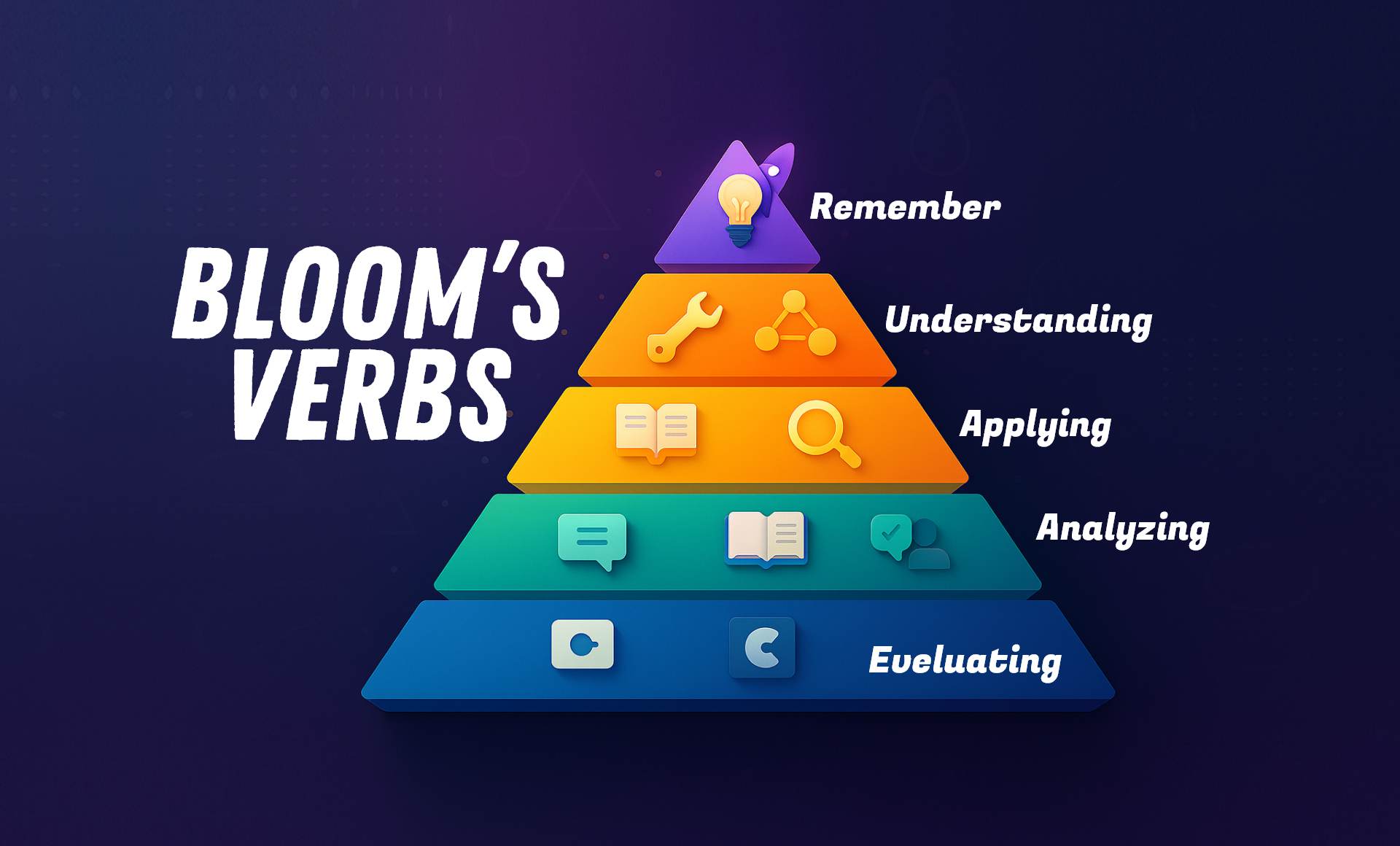
Bloom’s Verbs: A Complete and Practical Guide for Educators
Bloom’s verbs are essential tools in education for writing clear and measurable learning objectives. These verbs originate from Bloom’s Taxonomy, a well-known educational framework developed by Benjamin Bloom. The taxonomy organizes learning into different cognitive levels, and Bloom’s verbs help describe what learners are expected to do at each level.
Instead of vague objectives such as “students will understand” or “students will know,” Bloom’s verbs focus on observable actions like explain, analyze, evaluate, and create. This shift improves teaching effectiveness, student clarity, and assessment accuracy.
Today, Bloom’s verbs are widely used in schools, colleges, professional training programs, and online learning platforms.
What Are Bloom’s Verbs?
Bloom’s verbs are action-oriented verbs that align with the six cognitive levels of Bloom’s Taxonomy. Each verb represents a specific type of thinking skill, ranging from basic recall to advanced creativity. These verbs allow educators to design objectives that can be measured and assessed objectively.
For example, when an objective states that learners will analyze data or design a solution, it clearly shows the level of thinking required. Bloom’s verbs remove ambiguity and ensure that learning outcomes focus on student performance rather than teaching intentions.
If you want a broader, categorized list specifically focused on objective writing, you can also review these learning objective verbs here: Learn Objective Verbs
Why Bloom’s Verbs Are Important in Learning Objectives
Bloom’s verbs help ensure that learning objectives are student-centered, measurable, and aligned with assessments. When objectives use appropriate Bloom’s verbs, students know exactly what is expected of them, and teachers can evaluate learning outcomes more effectively.
They also promote higher-order thinking skills, encouraging learners to move beyond memorization toward critical thinking, problem-solving, and creativity. In curriculum planning, Bloom’s verbs help maintain balance across cognitive levels, ensuring that students are challenged appropriately.
Bloom’s Taxonomy and Cognitive Levels
Bloom’s Taxonomy is divided into six hierarchical cognitive levels, each associated with specific Bloom’s verbs. These levels progress from simple knowledge recall to complex creative thinking.
1. Remembering Level and Bloom’s Verbs
The remembering level focuses on recalling previously learned information. It is the foundation of learning and involves memory-based tasks. Bloom’s verbs commonly used at this level include define, list, identify, recall, recognize, name, and state.
At this stage, students demonstrate their ability to retrieve facts, terms, or basic concepts. For example, students may be asked to list historical dates or define scientific terms. While this level is essential, it does not involve deep understanding.
2. Understanding Level and Bloom’s Verbs
The understanding level goes beyond memorization and requires students to explain ideas in their own words. Bloom’s verbs associated with this level include explain, describe, summarize, interpret, classify, and compare.
At this stage, students show comprehension by translating information into meaningful explanations. For instance, they may explain the causes of climate change or summarize a chapter in their own words. This level builds a strong conceptual foundation for higher-order thinking.
3. Applying Level and Bloom’s Verbs
The applying level involves using learned knowledge in new situations. Bloom’s verbs for this level include apply, demonstrate, solve, use, illustrate, and execute.
Students at this level take theoretical knowledge and put it into practice. For example, they may solve mathematical problems using formulas or demonstrate a scientific procedure in a lab. The application helps learners connect theory with real-world situations.
4. Analyzing Level and Bloom’s Verbs
The analysis level requires breaking information into parts to understand relationships and patterns. Bloom’s verbs for this level include analyze, differentiate, examine, categorize, contrast, and investigate.
At this stage, students engage in critical thinking by identifying causes, motives, or underlying structures. For instance, they may analyze a case study, examine data trends, or differentiate between facts and opinions. This level strengthens reasoning and logical thinking skills.
5. Evaluating Level and Bloom’s Verbs
The evaluating level focuses on making judgments based on criteria and evidence. Bloom’s verbs associated with this level include evaluate, justify, critique, assess, defend, and recommend.
Students demonstrate the ability to form opinions and support them with logical reasoning. They may evaluate the effectiveness of a policy, critique a literary work, or justify a business decision. This level promotes independent thinking and decision-making skills.
6. Creating Level and Bloom’s Verbs
The creating level is the highest cognitive level in Bloom’s Taxonomy. It involves producing original ideas or products. Bloom’s verbs at this level include create, design, develop, construct, formulate, and compose.
At this stage, students combine knowledge from multiple areas to generate new solutions or ideas. Examples include designing a research project, developing a business plan, or composing a piece of writing. This level emphasizes innovation, creativity, and problem-solving.
Bloom’s Verbs in Assessments and Exams
Bloom’s verbs are widely used in designing exam questions and assessments. Lower-level verbs are often used in multiple-choice questions, while higher-level verbs are suitable for essays, projects, and presentations.
For example, a question using a remembering-level verb may ask students to identify key terms. In contrast, a creating-level question may require them to design a solution to a problem. This ensures balanced assessment and comprehensive evaluation of student learning.
Common Mistakes When Using Bloom’s Verbs
One common mistake is mismatching verbs with assessment methods. For instance, using a high-level verb such as evaluate but assessing it with a simple multiple-choice question reduces the effectiveness of the objective. Another mistake is overusing lower-level verbs, which limits critical thinking and creativity.
Educators should carefully align Bloom’s verbs with teaching strategies, activities, and assessments to achieve meaningful learning outcomes.
Conclusion
Bloom’s verbs are a powerful tool in education that help transform vague learning goals into clear, measurable objectives. By aligning teaching, learning, and assessment with Bloom’s Taxonomy, educators can promote deeper understanding, critical thinking, and creativity among students.
Whether used in lesson planning, curriculum development, or assessments, Bloom’s verbs ensure that learning is purposeful and outcome-driven. Mastering their use can significantly enhance the quality of education at all levels.
Frequently Asked Questions (FAQs)
1. What are Bloom’s verbs?
Bloom’s verbs are action words used to write measurable learning objectives based on Bloom’s Taxonomy.
2. Why are Bloom’s verbs important?
They help define clear learning outcomes and ensure assessments measure actual student performance.
3. How many levels are in Bloom’s Taxonomy?
There are six levels: remembering, understanding, applying, analyzing, evaluating, and creating.