Middle School Classroom Setup Guide: Layout, Organization, and Decor Ideas
Setting up a middle school classroom is not the same as setting up any other classroom. These are 11- to 14-year-olds who want to feel respected, not babysat, and the way you organize your space sends a message before you say a single word.
This guide covers the middle classroom setup, daily procedures, seating, and environmental choices that experienced middle school teachers swear by, backed by research on the recommendations.
What Makes a Middle School Classroom Different?
Middle schoolers occupy a specific tension: they need significant academic structure, but they also need to feel seen as young adults. That balance starts with the physical space.
The first impression your room makes on day one shapes how students perceive their learning for the rest of the year, and that is not an exaggeration.
Research shows that classroom environments that support student learning are highly personalized. It encourages active participation and the use of investigative skills in learning activities.
How Should a Middle School Classroom Be Set Up?
A well-set-up middle school classroom serves multiple learning modes, whole-group instruction, small-group work, independent reading, and quiet reflection, without requiring you to completely rearrange furniture each time. The goal is zones, not chaos.
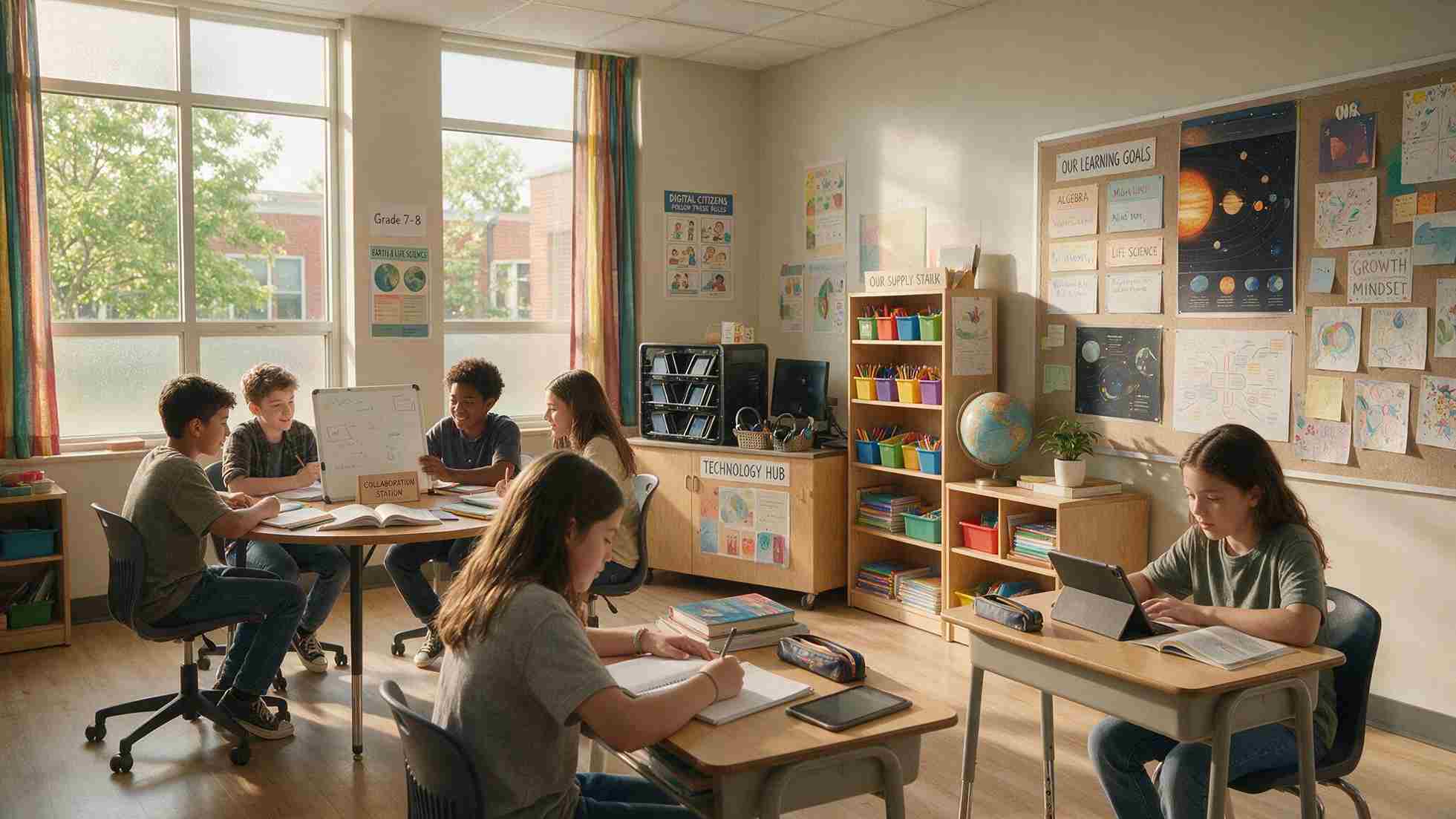
As you set up your middle school classroom, consider creating six distinct spaces to ensure that every bit of valuable real estate in your room is used efficiently.
Those zones typically include a student supply area, a focal point for instructions, a small-group table, a technology station, a labeled storage area, and bulletin boards that actually serve learning (not just decoration).
In a 2019 study, researchers made the case for creating multiple learning zones in your classroom, a main space for teacher-centered instruction and several smaller areas involving students actively working on tasks and reflecting on their work. Such classrooms often resulted in improved measurable student learning outcomes.
Start With a Clean, Labeled Space
Before any decor or furniture arrangement, clear out the clutter first. A clean, organized classroom isn’t just nice to look at; it’s crucial for student success. Desks, chairs, and supplies should all sit neatly arranged, with unnecessary clutter gone. Keep materials within easy reach, for students and for yourself.
Labeling matters more than most teachers expect going in. When students can find things on their own, they stop interrupting to ask. Honestly, the number one goal with middle school classroom organization is just this: keep it clean, keep it simple. Students who can locate something quickly tend to work more independently; they get right to work instead of stalling on questions.
One labeling strategy gets overlooked constantly: labeling items with both images and words, in whatever languages your students actually speak, supports organization and promotes inclusivity and language development at the same time.
Build a Student Takeoff Area
Every middle school classroom needs a supply area near the door, a spot stocked with pencils, paper, whatever else kids show up without. And they will show up without it. Teachers need a way to handle this the moment it happens, not after. When students walk in, they should be able to grab pencils, paper, or anything else they need right away. Small thing, but it starts class off right.
This isn’t about lowering expectations. It’s about removing a friction point that quietly eats the first five minutes of every class. A standardized supply spot means nobody has to ask, nobody has to wait, and you move straight into the lesson.
Choose Your Seating Arrangement Intentionally
Rows aren’t inherently bad. Neither are clusters. What actually matters is whether the layout fits how you teach most days.
Horseshoe seating improves sightlines and creates a natural setup for conversation, collaboration, and connection. The U-shape still lets the teacher lead while building a sense of community; desks face inward, so student collaboration happens almost by chance.
For middle schoolers bouncing between independent work and group tasks, flexible arrangements just work better. When tables stay fixed all day, every day, learning can start to feel that way too.
One practical note: blocked walkways can be a real hazard in an emergency. Students who use wheelchairs or walkers might need extra space to move, plus storage for any equipment they rely on. Plan your traffic flow before locking in the layout, not after.
If you teach multiple periods, try to create system: each period gets its own crate, and each student gets a folder inside it with a notebook and handouts. Classes change, students grab their folders, and they’re ready. Immediately.
Create a Small Group Area
Small-group instruction is where differentiated learning actually happens, not in the whole-class lecture. One way to make sure students with varied needs get what they need is to work with small groups in a space set aside just for that. Face the table and chairs away from the rest of the class to cut down on distractions.
Keep supplies right at the table. A rolling caddy stocked with manipulatives and materials means nobody leaves the group hunting for something. That five-step walk across the room to grab a marker? That’s exactly the moment the rest of the group loses focus.
Set Clear Procedures From Day One
Physical setup only carries you so far. Procedures are what actually make a middle school classroom run smoothly across a whole year. Clear, consistent routines are essential for smooth operations and real learning. Explain how students enter the room, where belongings go, and what prep looks like before the lesson starts. Put it in writing, where and how assignments get turned in, no ambiguity.
A daily agenda board, posted in the same spot every day, solves more problems than most teachers give it credit for. Writing the week’s agenda on the whiteboard keeps you on track with your own lesson plans and gives students something predictable to lean on.
Post the homework, the daily objective, and the entry task in the same spot, every single day. Do this, and students stop asking “what are we doing today?” Within two weeks, usually.
Where possible, sync up with other teachers so procedures stay consistent school-wide. Working as a team gives students a more cohesive experience. And that consistency does something subtle but real: it builds familiarity, which cuts down on anxiety.
Design the Walls to Work, Not Just Look Good
Bulletin boards in a middle school classroom should earn their space, not just fill it. Research suggests moderation is the key word here, classroom decoration can shift academic trajectories, and the rule of thumb is fairly simple: hang academically relevant work, skip the extremes in either direction.
Color palettes matter too, more than people assume. Skip extreme wall colors, black and neon green, and go for a pleasant mix across walls, floor, and displays instead.
Display student work over store-bought posters whenever you can manage it. Across the year, students should be creating most of what ends up on their own walls. A classroom that reflects student voice and a bit of positivity just feels friendlier, and students notice.
Add a Calming Mood Space
This one surprises some teachers. It pays off anyway. Hanging lights, lamps instead of harsh overhead fluorescents, some soft tonal music in the background, all of it nudges students toward a calmer state, one that’s just more conducive to actually learning.
A calming corner doesn’t need to be big. A beanbag near the window, a small lamp, one visual to anchor the space, that’s enough. For students managing anxiety (which, let’s be honest, is just part of adolescence), having somewhere to reset without leaving the room keeps them in class instead of in the hallway.
Temperature matters more than people think, too. A 2018 study found that a one-degree Fahrenheit rise in local temperature corresponded to roughly a one percent drop in test scores. If you have any control over your room’s temperature at all, use it.
Organize Missed Work So It Doesn’t Consume You
Here’s one of the more practical organization strategies for a middle school classroom: a dedicated missed-work system. Group missed assessments by binder clip, blank sheet on front showing the student’s first name, the assessment name, and the date. Then hang it with a magnetic push pin on the whiteboard nearest your desk. When a student shows up to make it up, you find it in seconds, not minutes spent digging through a drawer.
For handouts, a monthly binder with page-protected daily slots lets you pull any make-up work instantly and doubles as planning material for next year.
Support Student Agency
Middle schoolers learn more when they feel some real ownership over the room and its routines. One approach that works well: student ambassadors. A student ambassador reads the objective, essential questions, and agenda each day. Concept review, group work, discussion, reflection, goal setting, all of it can be student-led, at least partly.
Classroom jobs do something similar on a smaller scale. Assign supply managers, paper distributors, and board erasers, and rotate them regularly. The jobs themselves take thirty seconds. But they give students a stake in keeping the space running, and that stake matters more than the thirty seconds suggest.
Frequently Asked Questions
1: What is the best seating arrangement for a middle school classroom?
There is no single best arrangement; it depends on how you teach. Horseshoe and cluster arrangements work well for discussion and collaboration. Rows support focused independent work. If you teach 90-minute blocks, consider keeping one section of the room flexible so you can rotate small-group instruction without moving every desk.
2: How do you make a middle school classroom feel welcoming?
Warmth in a middle school classroom comes from a combination of physical and relational cues. Display student work prominently, label everything so students can be independent, add soft lighting where possible, and keep the room uncluttered.
3: How many students are in a typical middle school classroom?
In the United States, the average middle school class size is between 20 and 30 students, though this varies by district, subject, and funding. Research consistently shows that smaller class sizes allow for more differentiated instruction and stronger teacher-student relationships, both of which are positively linked to academic outcomes in the middle grades.
4: What should be on the walls of a middle school classroom?
Walls should display academically relevant content, student work, vocabulary, objectives, and reference materials that students actually use during class. Avoid decorating purely for aesthetics. Research from the University of Salford found that classroom design elements, including wall displays, accounted for a measurable portion of variation in student academic progress. Aim for a balance: enough visual information to support learning, not so much that the space becomes overstimulating.
5: How do you manage a middle school classroom with multiple preps?
A crate or folder system by class period is the most teacher-tested solution. Each class period gets a crate; each student has a folder inside it. As periods rotate, students collect their folders rather than the teacher managing thirty individual sets of materials. A weekly agenda board with rows for each prep and columns for each day of the week handles planning visibility. Color-coded systems for grading and filing by prep reduce mistakes when you are moving fast between subjects.